Game-Based Learning in Digital Healthcare
September 29, 2026 | DigiTrøndelag, Norway
In an initiative involving DigiTrøndelag and Agenda Kaupang, leaders from 15 Norwegian municipalities used Actee Change to explore real-life challenges, navigate employee resistance, and practise making decisions that support successful organisational change.


Game-Based Learning in Digital Healthcare
On Monday, September 21, and Tuesday, September 22, 32 participants from municipalities across Trøndelag, Norway, gathered to take part in game-based learning.
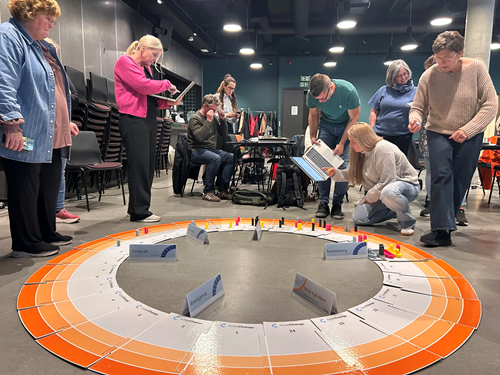 The Actee Change game platform, participants were immersed in a realistic simulation of a change management process. (Photo: Anne Kari Haugdal)
The aim of the event was to explore how municipalities could become more successful in implementing and scaling healthcare technology.
Traditional PowerPoint presentations were not on the agenda when 15 municipalities came together for professional development. Instead, much of the learning took place through a large-scale board game.
Using the Actee Change platform, participants were immersed in a realistic simulation of an organisational change process.
Challenges, Opportunities, & Decisions
During the game, participants followed the story of a municipality introducing digital monitoring as part of an integrated service delivery model.
Throughout the simulation, they encountered challenges reflecting real-life change processes. Some employees welcomed the changes, while others were sceptical and uncertain about whether the new technology would benefit the people receiving care.
The participating leaders then explored the options and decisions available to them to bring everyone on board.
The game clearly made an impression. In the post-event evaluation, the simulation was by far the most frequently mentioned element, with overwhelmingly positive feedback.
Many participants also found it valuable to learn more about change management and the balance between management and leadership.
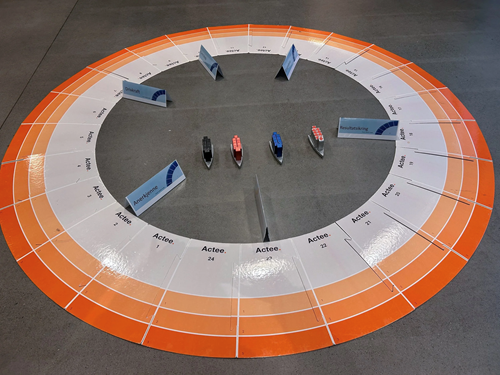 Change management through gameplay: Participants followed the story of a municipality introducing digital monitoring as part of an integrated service delivery model. (Photo: Anne Kari Haugdal)
The Value of Working Together
Anne Kari Haugdal, head of DigiTrøndelag's professional network for digital healthcare, was very pleased with the event. However, she emphasised that the digital healthcare network in Trøndelag is just one of several contributors to the initiative.
Inger Lise Helgesen, Project Manager at Inderøy Municipality, highlighted the importance of having concrete goals to work towards rather than focusing solely on leadership theory.
"I hope that all municipalities participating in the integrated service delivery model will benefit from this. If we don't succeed in establishing a solid foundation for how to realise the benefits, change management alone won't be of much use," she explained.
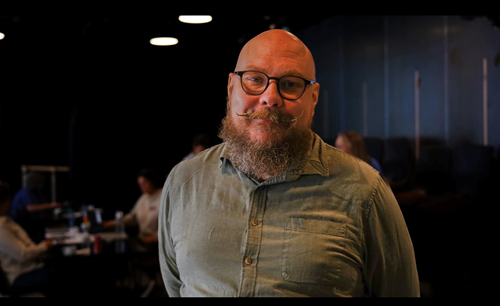 Making the connections: "Change management and governance must go hand in hand with benefits realisation if we are to succeed in delivering services," says Per Anders Fosslund, Digitalisation Advisor and Project Manager at Verdal Municipality. (Photo: Håvard Zeiner)
Looking Beyond Your Own Organisation
For Per Anders Fosslund, Digitalisation Advisor and Project Manager at Verdal Municipality, one of the most important aspects of the event was the opportunity to look beyond his own organisation and recognise that other municipalities face many of the same challenges.
"Through the discussions and simulation, it became clear that change management and governance must be connected to benefits realisation if we are to achieve real success in service delivery," he said.
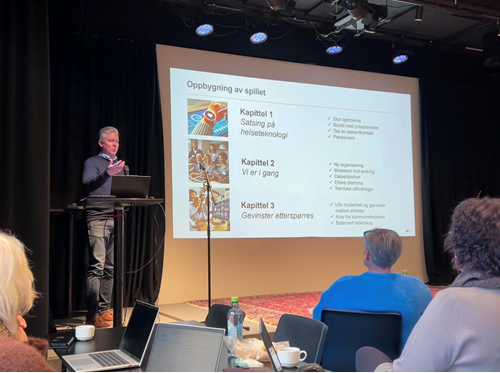 Ready, Set, Play: Amund Breda from Agenda Kaupang explains the game to participants. (Photo: Bjørn-Erik Rossing Gullikstad)
Looking ahead, Fosslund and the other participants plan to explore shared implementation processes and projects to strengthen their ability to carry out healthcare technology initiatives.
Fosslund also stressed that healthcare technology must be experienced as an integrated part of everyday service delivery rather than simply as a standalone project.
"Many municipalities in Trøndelag have very small populations. We therefore need to be willing to ask ourselves what challenges this creates for integrated service delivery models and for the wider adoption and scaling of healthcare technology."
Supporting One Another Along the Way
Smaller municipalities often have limited resources, meaning that a small number of people must manage everything from daily operations to strategic development.
Naturally, this makes it difficult to dedicate sufficient time to continuous service improvement and monitoring the benefits of new initiatives.
Greater collaboration across municipal boundaries was identified as one way to support more integrated service delivery models and the wider adoption of healthcare technology.
What does it take to make this collaboration successful?
"Shared goals, commitment, and processes. Clear roles and responsibilities, and, above all, creating a culture where we share knowledge and expertise and support one another along the way," Fosslund concluded.
Original article: DigiTrøndelag, September 29, 2026
Source: https://www.digitrondelag.no/aktuelt/ghtpgzh28bzwsnmzpwnxadhtc9xmmt
Translated from Norwegian into English for publication as an Actee customer reference.
 This website uses cookies. You agree to the use of cookies by clicking on the page.
